
If you do not work in Italy, the phrase agenda legale may sound fairly generic. You might imagine a legal calendar, or perhaps a diary app adapted for lawyers. In Italy, though, it refers to something more specific: a working tool built around the daily reality of legal practice.
An agenda legale is a long-established tool of the Italian legal profession. For decades it was a familiar physical object on almost every law office desk: not just a place to note appointments, but a system for keeping hearings, deadlines, case files and daily priorities under control.
That definition starts in Italy, but the need behind it does not. Lawyers in many countries may use different words, follow different procedural rules and work in different courts, yet the underlying pressure is recognisable everywhere: too many moving parts, too many deadlines, too much risk in letting context slip away.
More than a calendar
A generic calendar helps you schedule meetings. In the Italian legal tradition, an agenda legale helps you stay on top of the live workload of a practice.
At its core are not just dates and times, but above all:
- hearings
- procedural deadlines
- required filings and next steps
- links to case files
- the practical notes that matter during the day
That distinction matters. A lawyer does not simply need to know when something is happening. They need to know what is happening, for which matter, with what priority, and what is at stake if something is overlooked.
That is precisely why the idea translates so well outside Italy too. A lawyer in London, Lisbon or Sao Paulo may not use the term agenda legale, but they immediately recognise the need for a legal diary that keeps the day connected to the matter, the deadline and the next decision.
Why it became so important in Italy
In Italian legal practice, time is not just background structure. It is part of the profession itself.
Hearings shape the working week. Procedural deadlines demand constant attention. Adjournments alter the flow of work. Missing a deadline is not just an organisational inconvenience: it can affect a case, a client, and sometimes the lawyer’s own professional responsibility.
In many situations, these are not flexible dates but strict legal deadlines. Missing one can trigger forfeiture, procedural preclusion, or the loss of the opportunity to take a defensive step in the case. That is one of the reasons many Italian lawyers have such an intensely personal relationship with their agenda.
This is why, in Italy, the agenda legale has never really been seen as an accessory. It has always been treated as a tool of control, continuity and professional reliability.
Why lawyers abroad relate to it so quickly
Once you explain the concept, most lawyers do not need much convincing. They already know the daily friction it solves.
They know what it means to prepare for a hearing while keeping an eye on the next filing. They know the cost of switching between a calendar, a task list, a case archive and scattered notes. They know that legal work is rarely just about appointments: it is about context, continuity and reducing the chance of mistakes.
That is why the Italian idea of an agenda legale makes sense well beyond Italy. It gives a name to a way of working that many lawyers have been looking for, even if they have never called it that.
A historic object before it was a digital one
Before apps, before cloud sync, before working across multiple devices, the agenda legale was a recognisable physical object. It had a clear format, a familiar language and a fixed place in the lawyer’s day.
You opened it in the morning to review that day’s hearings, the work that needed preparing and the deadlines approaching. You checked it throughout the day to keep your bearings between case files, adjournments, notes and commitments. You closed it in the evening with the very concrete feeling that the work was still under control.
That is why, for many Italian lawyers, the idea of an agenda does not simply overlap with the idea of a calendar. It carries a specific professional tradition with it. What matters today is that this tradition turns out to be remarkably modern: it starts from legal work as it is actually done, not from a generic scheduling template.
More memory than appointment list
A well-kept agenda legale does not only help you remember the future. It also helps you reconstruct the present.
Looking at a single day, a lawyer needs to understand at a glance which hearings are scheduled, which deadlines are still open, which matters require attention and which notes are operationally relevant. In that sense, the agenda is memory, order and method all at once.
It also helps govern the calculation of time limits, which in legal work does not always follow the simple logic of an ordinary calendar. Public holidays, adjournments, suspension periods and counting rules make time far more delicate than it may appear to an outside observer.
That is another reason many lawyers develop a deeply personal relationship with their agenda legale. It is not just a tool they use. It is a tool they orient themselves within.
What changes when it becomes an app
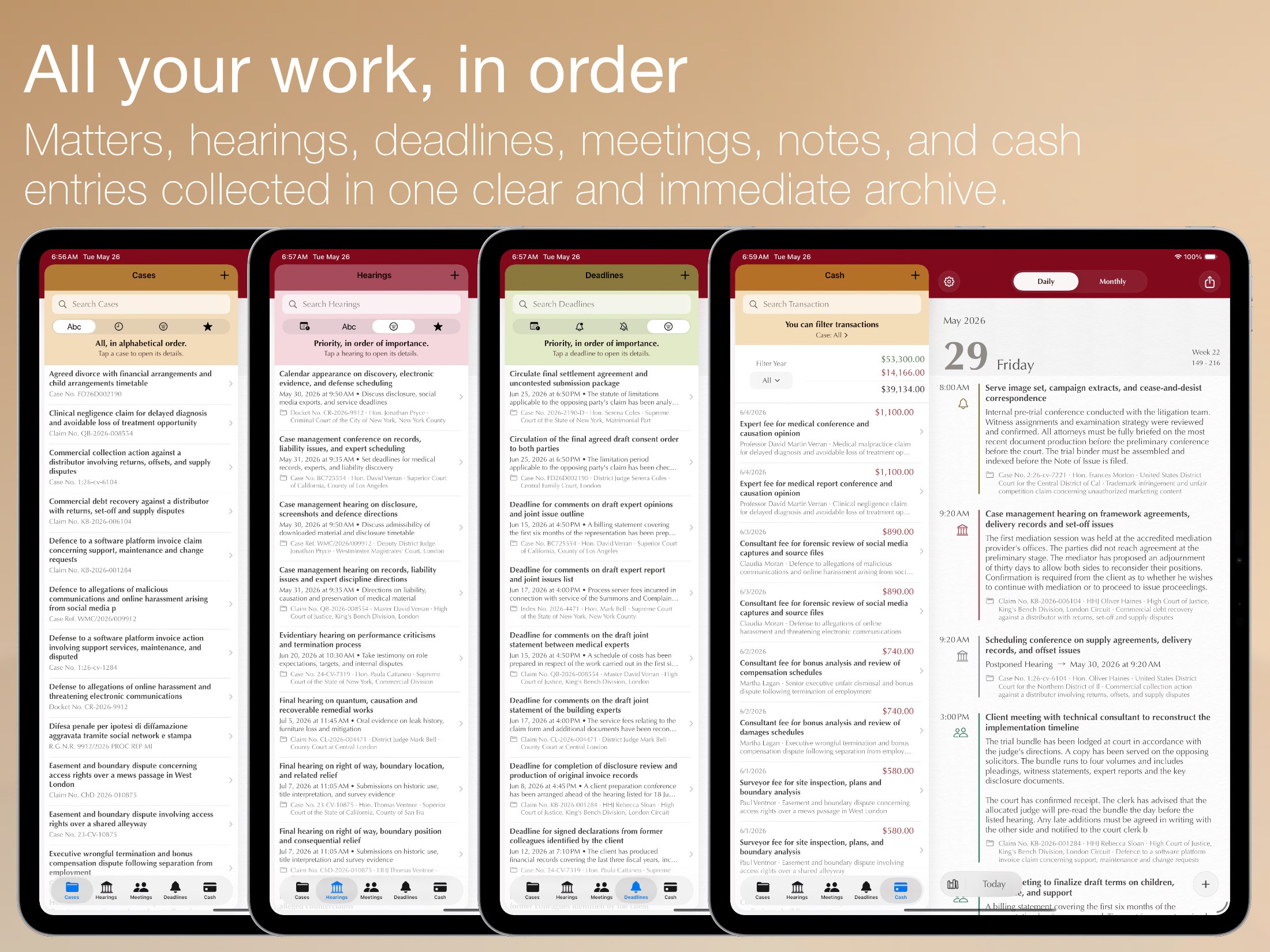
When this tradition moves from paper to digital, the real question is not how to copy a calendar onto a screen. The real question is how to preserve that way of working while making it even more useful across devices, teams and jurisdictions.
A good digital agenda legale should retain the same core logic:
- hearings at the centre
- deadlines always visible
- linked case files
- fast consultation
- continuous updates
The advantage of digital tools is that they can add new possibilities — sync, search, sharing, work across devices — without losing the clarity and discipline of the original model.
For lawyers outside Italy, that matters even more. A legal diary only becomes truly useful internationally if it feels natural in everyday practice: in the language you work in, with the regional settings you expect, and with calendars and public holidays that match your jurisdiction.
Why this also explains Counsel Planner
This is exactly the tradition Counsel Planner comes from. It was not conceived as a generic calendar for legal professionals. It grew out of a very precise Italian professional model, but its direction has been international for a long time.
The app has spoken English since 2016. Since then, it has been used and appreciated by lawyers well beyond Italy, precisely because the core idea is not parochial at all: it is practical. Put the agenda first. Keep hearings and deadlines visible. Keep related matters close at hand. Reduce friction in the middle of a busy working day.
That is why the new version is moving further in the same direction. More languages, regional settings, jurisdictions and public holidays are not cosmetic additions. They make the experience more natural for lawyers in different countries, while keeping the same disciplined structure that made the original Italian model so effective.
Outside Italy, the phrase agenda legale may need explaining. But once it is explained, the appeal is easy to understand. The term is Italian. The need it describes is not.
If you want to see how this idea shaped the new app, you can also read the story of Counsel Planner and our guide on moving from the old app to the new one. If you have questions, write to us at support@counselplanner.app.